SDSU students confront fast fashion’s waste and discover new ways to shop sustainably.
By Denali Norton
Story Highlights
* The fashion industry emitted 879 million metric tons of carbon dioxide in 2022, according to Statista.
* “The first thing you should do is repurpose the clothing you already have before you think about buying something new,” said Jazlyn Piera, a San Diego State University senior.
* At San Diego State University, the Associated Students organization Green Love Commission, hosts a semesterly Swap Shop for SDSU students to engage in more sustainable clothing consumption.
San Diego -College students and shopping have always gone hand in hand, from Halloween costumes to party themes, new clothes are almost a necessity of the college social scene. Fast fashion companies are one avenue for that self-expression, but some students have found a more creative alternative.
Visit TikTok HERE to see students at the swap shop!
Fast fashion refers to new, trendy clothing sold at an affordable price, often with hundreds of new styles coming out every day. Fashion is made affordable for the budget-conscious. The dark side of this mass-produced affordability includes overproduction and consumption.
Fast Fashion By the Numbers
In 2019, Zara sold almost 3 billion units of merchandise, according to Statista. As the rise of fast fashion continues to reach new heights in popularity, the search for sustainable options is on the minds of many.
According to Statista, the apparel industry emitted approximately 879 million metric tons of carbon dioxide equivalents into the atmosphere in 2022.
“There's a lot of waste in the world from clothing and textiles, especially from fast fashion,” Arwen Handel, sustainability commissioner for San Diego State University Associated Students, said. “I think college students that don't have a lot of money are very drawn toward fast fashion because we live in a very consumerist culture, especially here at SDSU.”
The popular fashion brand Uniqlo and GU stores generated 38,000 tons of waste in 2024. While the fashion industry as a whole produces 92 million tonnes of waste per year, according to the United Nations Environment Program, this data can seem overwhelming, given the world's excessive waste production. Is there a way for college students to avoid it?
One way to address this issue and find a way to make a difference, even on a small scale, is to examine your own personal consumption habits. How often do you buy something you don't really need?
What can you do about it? Alternatives to shopping for fast fashion
SDSU students concerned about the fast fashion crisis find new and creative ways to make an impact in their personal consumption habits.
“The first thing you should do is repurpose the clothing you already have before you think about buying something new,” Jazlyn Piera, an SDSU senior, said.
From mending to completely upcycling, your old clothes are a great way to create something new from something old. If you do find yourself needing something, finding it second-hand at a thrift store or on a reselling app like Depop, Poshmark, Mercari, or ThreadUp is a good start.
“See what you can borrow or grab from friends,” Juliana Marie, an SDSU senior, said. “Everyone has a stash of clothes they’re sitting on that they don’t really wear anymore.”
Thrifting: a sustainable option to find something new
SDSU’s student-led magazine, The Look, focuses heavily on fashion, apparel, and aesthetics. The magazine sources all of its clothing from the closets of its members, according to Mariah Crandall, the co-styling vice president for The Look. She prioritizes a thrifted look in all of her styling, noting the uniqueness of finding something at a thrift store or in someone else's closet.
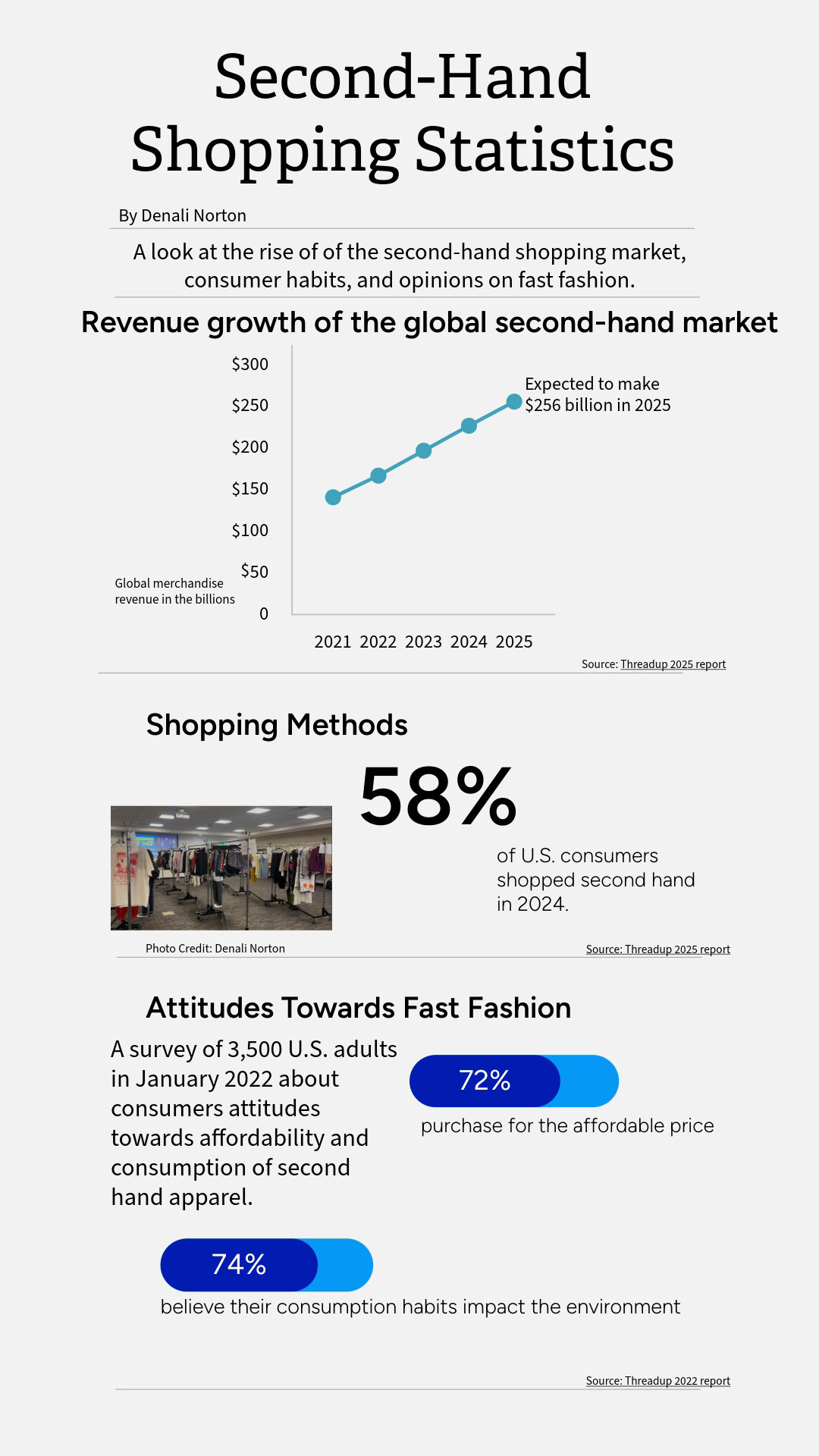
The global resale market is estimated to reach $256 billion in 2025, according to the Threadup resale report. More sustainable shopping methods are gaining popularity, but what consequences will they have for consumers as the industry continues to expand? Will second-hand clothing start to price out consumers' budgets?
According to the 2025 Threadup Resale Report, 58% of consumers shopped second-hand. More and more people are turning to thrift stores to find unique options, be more sustainable, and reduce their consumption.
In a culture that values consumption, many young people who are tight on money turn to fast fashion. In 2022, the Threadup Resale Report surveyed 3,500 U.S. adults and found that 72% of consumers stated they shop fast fashion due to its affordable prices. Even though 74% of those surveyed believe their consumption habits impact the environment.
Smaller community-focused events are one way to make sustainable shopping options affordable. Local businesses and events put on by the community are ways to keep second-hand clothing inexpensive.
Associated Students’ Green Love Commission Swap Shop
The Green Love Commission pop-up Swap Shop, an initiative that was started seven years ago, aims to create sustainable ways to shop for new clothes within the SDSU community.
Kira Lussier, an SDSU senior, dropped off her old clothing the morning of the swap shop in exchange for a swap voucher for the swap that afternoon. Walking through the makeshift clothing aisles in the Student Union, a few items caught her eye. It was almost like being in a thrift store. By the end of her time at the swap, she walked away with a few new items, her favorite being a long green skirt with an interesting hem.
“I feel like I thrift all my clothing or borrow stuff from friends, it's pretty rare that I buy something new,” Lussier said. “I also try to make sure I donate or sell my clothes when I’m done using them instead of throwing them out.”
The swap allowed her to find new clothing in a sustainable way that gave back to the SDSU community, knowing all the clothes donated would go to students, and the leftovers to a project that is run by the Mustard Seed Project, which aims to give homelessness relief.
“Having an outlet where people can get clothes that are literally free instead of buying them cheaply off platforms like Shein or Amazon is a really good way to promote a more sustainable and thoughtful consumption of clothing,” Handel said.